
Blog
The History of Neon Signs: From Gas Tubes to LED Neon

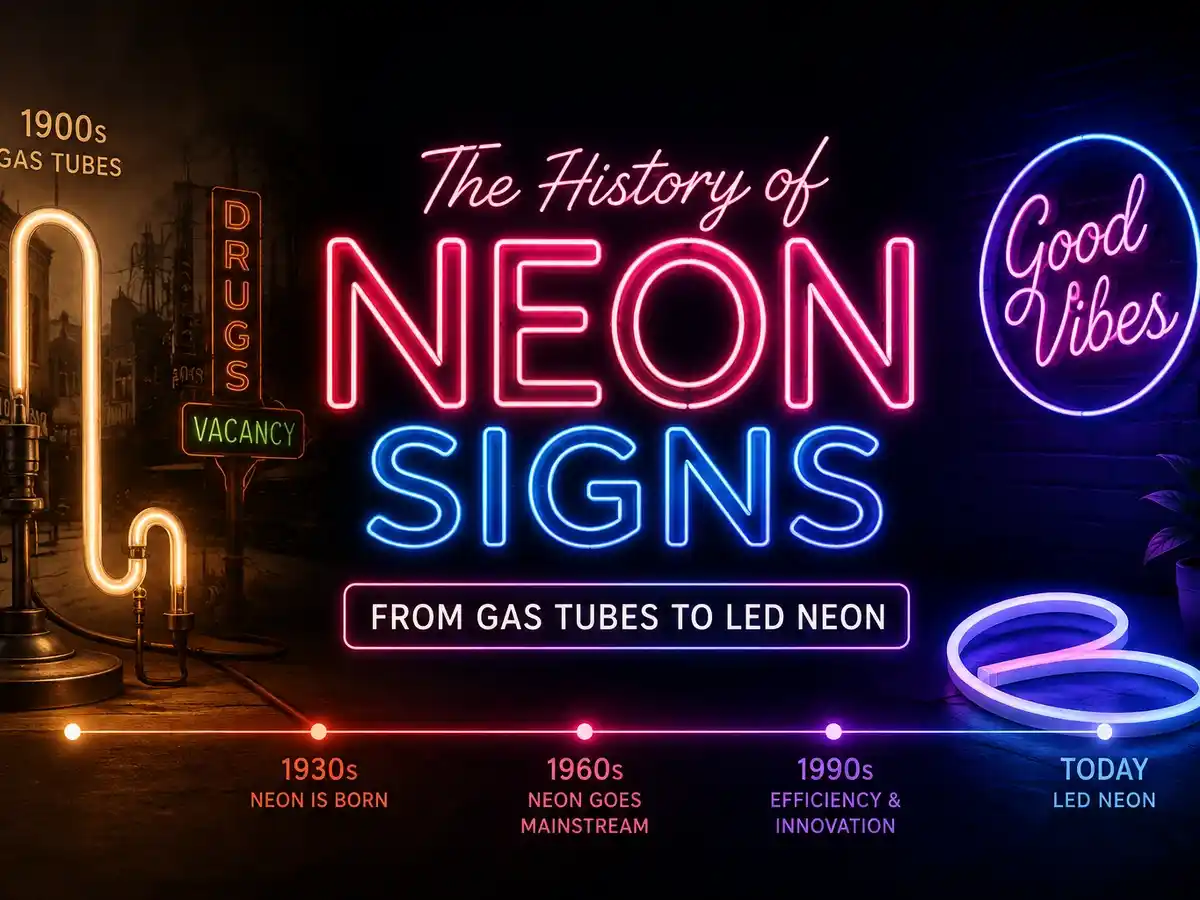
The Neon Sign is one of the most influential innovations of modern cities, changing the skyline from gas tubes to LED neon. Over a century ago, the idea of neon signs first emerged as storefront displays that literally glowed in the dark, and the warm, soothing light and aura of neon have since dominated restaurant walls, movie theaters, roadside inns, and the cityscape ever since.
Neon Signs in Australia represent layers of scientific research, business ventures, rebellion, and innovation. Today, with the replacement of the glass tube by an LED neon sign, it is useful to follow all the steps of this luminous art, starting from a Parisian lab and ending with the revival of the digital era.
The Scientific Discovery That Started It All
The Neon Signs are a flash of inspiration in scientific thinking. Advertising is not a starting point for neon signs; it is a point of origin, as neon signs started their history in chemistry first.
In 1898 British scientists William Ramsay and Morris Travers discovered neon gas. The gas gave off a spectacular red glow when it was made to be excited in a sealed glass tube. The discovery was a laboratory curiosity for over a decade and only useful for scientific instruments or products which were not commercially available due to the rarity of the gas, the difficulty in isolating it, and its high cost when produced.
Georges Claude: The Man Behind the First Neon Sign
This brilliant idea of commercializing the glowing tube came to a French engineer who worked in industrial gases.
The Man Behind the First Neon Sign
The guy behind the first Neon Sign. This engineer was Georges Claude, a French chemist who had built up a profitable business for industrial liquefaction of air. In fact, neon had been one of the by-products of his process for separating the air, and Claude discovered that when he sent an electric current through the purified gas, it glowed with a bright, steady light that no one had ever seen.
In December 1910, he exhibited the invention at the Paris Motor Show, the Grand Palais being lit up with two long red-tube lighted chambers. The display mesmerized viewers, but it wasn’t long before Claude realized that its real power wasn’t in home lighting, it was in signage.
By 1912 he had sold his first commercial neon sign to a Parisian-style barbershop and the era of neon signs was on.
Neon Signs Arrive in America
In the early 1920s, neon technology was introduced in America, when the company brought the technology in to promote one of the city’s Packard car dealerships in Los Angeles.
Neon was taken up by Americans, which were already car or nightlife obsessed. Neon tubing could be shaped into virtually any form possible, unlike incandescent bulbs and sign makers could craft custom lettering, logos and illustrations that glowed in the daytime and made a striking effect after dark.
As it happened, in just a few years, the neon signs started to show up in big cities across the United States, and business people soon realized that neon could get people’s attention from blocks away.
The Golden Age of Neon Signs
The neon’s golden age is said to be between the 1920s and the 1950s. New York’s Times Square was a spectacular visual feast of neon billboards, some of which were by the hand of advertising masters such as Douglas Leigh, who made advertising a show.
By 1940, there were almost 2,000 shops in the United States making neon signs, making them an integral part of American commercial culture.
Neon was used by motels, diners, casinos and movie theatres to convey glamour, modernity and excitement. In particular, neon was used in Las Vegas to create a whole identity of light, color and spectacle which continues to characterize Las Vegas today.
The Science Behind Neon Signs
The Glow Explained
Neon Signs are easier to appreciate and understand when you know the science behind them.
Classical neon signs consist of a collection of hollow glass tubes with the gas filling them being one of the noble gases, bent into various shapes to produce the desired lighting effect.
This gas can be neon, which gives off a red-orange glow, or it can be argon mixed with mercury vapor, which creates blue and other colors when mixed with phosphor coatings.
At the ends of the tube electrodes are placed on a high-voltage transformer. The application of electricity to the gas causes the atoms within the gas to become excited and thus to glow.
Bending the glass and filling it with gas took some very special skills, and for this reason the Neon benders were considered more artisans that mere technicians.
The Decline of Traditional Neon
Neon fell out of use in the middle of the 20th century.
Although popular, neon signs started to lose ground after World War II. Hand blown signs were not used for commercial lighting in many cases because of plastic or Plexiglas signs which were easier to manufacture and less breakable, and fluorescent lights were more convenient for interior lighting.
Neon seemed to be an anachronism by the 60s and 70s, when it was more suited to late-20th century old motels and down-at-the-heels eaters than the next big thing.
Maintenance was another problem, neon tubes needed specific technicians to service them and as fewer and fewer people become trained in the trade, maintenance of old signs became increasingly difficult and costlier.
The Neon Renaissance
From Commercial Signage to Cultural Art
A brief look at the Neon Renaissance and how outmoded relics have become cultural artifacts.
Neon did not really perish. It has come back to life as an art form. During the 1980’s, neon signs were recognized as cultural artifacts and not a relic of commerce.
Neon signs were first recognized by the artists, collectors, and urban preservationists as more than a relic of commerce, but cultural artifacts, during the 1980’s.
There were the beginnings of neon history museums and vintage signs were popular to collect.
There was also the reimagining of neon by pop culture, where neon looks in film and TV evoke notions of nostalgia, rebellion and urbanity.
It was a new-found appreciation which kept the art of neon alive and has paved the way for the next great chapter in neon’s life, when its commercial relevance was decreasing.
The LED Neon Revolution
The most notable development to affect the neon sign industry since its original invention by Georges Claude has been the advent of LED neon in recent years.
LED neon signs are made from flexible silicone tubing that contains small light emitting diodes (LED) that create the same effect as a real neon sign, not glass tubes filled with gas.
This has made the use of neon style signage more accessible than ever before.
LED neon is much more affordable to manufacture, much longer lasting and much simpler to install and maintain than glass neon.
In the past, small business owners, event planners and even home decorators have been turning to LED neon signs for weddings, bedrooms, bars and store front spaces, leading to a huge revival of interest in the neon aesthetic.
LED Neon vs Glass Neon –What Are the Differences?
LED neon signs can achieve a fairly close resemblance to the traditional neon, although there are some distinctions.
The traditional glass neon is difficult to make, fragile, costly, and requires the expertise of a glass bender, injection of gases and high voltage transformers but many fanatics like the original look and artisan quality.
Compared to traditional neon, LED neon is easily dimmable, can be controlled remotely, has color changing capabilities and requires substantially lower power consumption, with little heat generated.
In most modern commercial and residential applications, LED neon offers most of the look at a much lower cost and maintenance.
The Future of Neon Signs – Blending Tradition with Modern Technology
See the types of custom signs getting more and more popular on this latest current date. These signs help businesses to attract more customers using less energy therefore they are also environment friendly as well.
With a focus on sustainability and energy efficiency, neon signs are set to reach greater heights as LED signs continue to grow and claim a larger share of the market, and it is likely that glass neon will continue to be used in smaller market sectors of art, heritage restoration and luxury branding.
Some sign makers are even going a step further by using traditional design sensibilities in combination with LED to produce hybrid products that celebrate the past but embrace its future and modern technology.
Whether it’s a neon sign or a neon shirt, the fascination and attraction of neon — this warm, glowing, obvious retro-futuristic light — is not going away any time soon.
Conclusion
The story of neon signs is one of transformation, artistry, and innovation, from Georges Claude’s pioneering work at the 1910 Paris Motor Show to the many different and intricate uses the signers have in the modern world, lighting up bedrooms and boutiques around the world.
Far from being an obscure gas, or a gas in short supply in World War II, or a gas being used in place of another during the 1970’s, neon, like other gases, has proved remarkably resilient and adaptable, constantly reinventing itself.
From this history, you’ll appreciate the beauty that continues to sparkle on the street, in the storefront, and in your mind through glowing channel letters, whether they’re vintage or contemporary.